Resources
Understanding Biometrics: Three Signals, One Clear Read
RE measures your heart rate before and after every breathing session so you can see your body's response in real numbers.
Informational and self-regulation purposes only. Not a medical device.

Each metric answers a specific question about your physiology. Recovery reads your immediate state right now, Coherence tracks how closely your heart locks onto your breath during a session, and Balance tracks your overall trend over weeks.
What your body is telling you
Recovery
RMSSD · beat-to-beat HRVYour immediate nervous system state after a scan.
Recovery measures beat-to-beat HRV (RMSSD) to reflect vagal tone, the rest-and-digest branch of your nervous system. Higher values indicate that your body can downshift quickly after exercise, stress, or poor sleep.
Coherence
breath–heart synchrony · 0.1 HzReal-time synchrony between your breath and heartbeat.
When you breathe at your resonant pace, your heart rate rises and falls in rhythm with your inhalation and exhalation. Coherence tracks this alignment in real time while you use the guide.
Balance
7-day rolling HRV vs. your 60-day baselineYour multi-week baseline trend compared to your history.
Daily HRV fluctuates with caffeine, sleep, and daily stress. Balance smooths seven days of resting readings and compares them against your 60-day baseline to show whether your nervous system is recovering or carrying cumulative strain.
Two ways in: watch, or camera
Balance uses your resting heart rate variability. RE syncs automatically with a smartwatch or calculates your baseline from camera fingertip scans.
Smartwatch Sync
- Connect once under Health Integrations to grant heart-rate access.
- RE reads up to 90 days of resting HRV recorded by your watch.
- Updates automatically from your watch data without manual scanning.
Camera Scan
- Place your fingertip over the camera lens for a quick resting scan before a session or during the day.
- Each scanning day contributes one day toward your baseline.
- Your Balance baseline unlocks after 14 logged daily readings.
Post-session readings: Scans taken immediately after breathwork show an elevated state. To maintain an accurate baseline, Balance counts only resting readings taken before sessions or on their own.
During setup, Balance displays "Building, day X of 14." The trend line begins drawing at 3 days, and your baseline corridor opens after 14 days.
Key Baseline Principles
Personal Baseline
Compare only to your own history. HRV baselines vary between individuals.
7-Day Rolling Average
The trend line averages seven days of readings across 30 to 90 day windows to show genuine shifts.
Wellness & Self-Regulation
RE is designed for relaxation and coherence training, not for clinical or medical diagnosis.
How to Breathe with RE: Guide & Practice Video
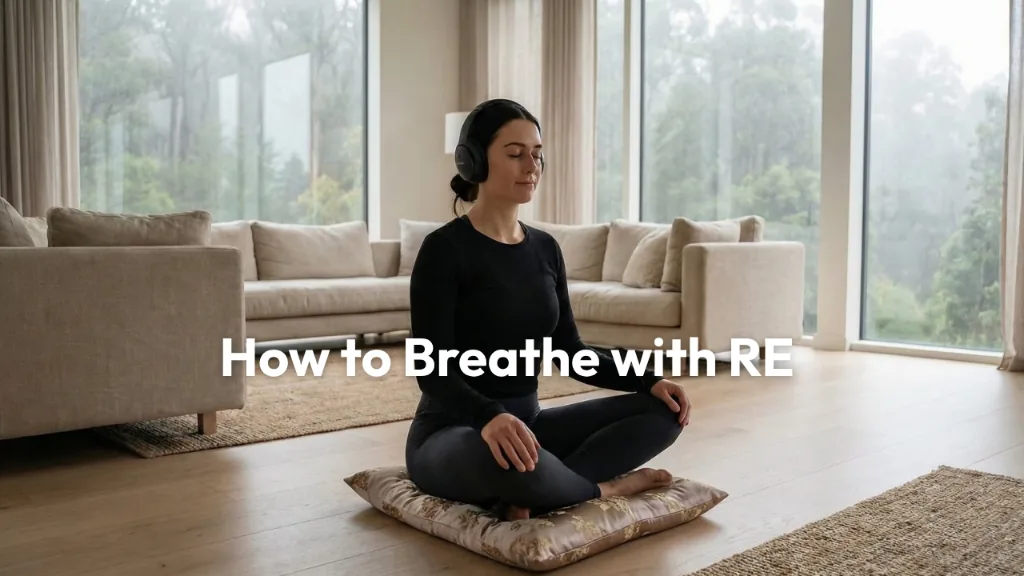
RE uses subtle audio pitch cues instead of screen animations. A rising tone guides your inhale and a falling tone guides your exhale, allowing you to keep your eyes closed throughout the session.
A Comfortable Position
Choose a relaxed seated or lying position. Release tension in your shoulders and jaw without forcing a rigid posture.
Helpful Tip: If sitting causes lower back strain, lie flat with a pillow supporting your knees to help your body relax.
Your Breath with the Sound
Inhale gently through your nose as the audio tone rises. Exhale smoothly through your nose as the tone falls.
Nasal Nitric Oxide: Nasal breathing releases nitric oxide, helping open bronchial pathways for oxygen transport.
Continuous, Wave-Like Breath
Keep your breath flowing continuously without holding at the top of the inhale or bottom of the exhale.
Baroreflex Resonance: Avoiding breath holds keeps heart rate variability smooth, supporting stable blood pressure pacing.
Gentle Attention and Return
Notice when your attention drifts and return your focus to the physical sensation of breathing and the audio tones.
Watch the Guided Practice Video
Experience how the rising high tone and falling low tone pair with smooth wave breathing in this short demonstration video.
Three Breathing Methods: Targeted Autonomic Shifts
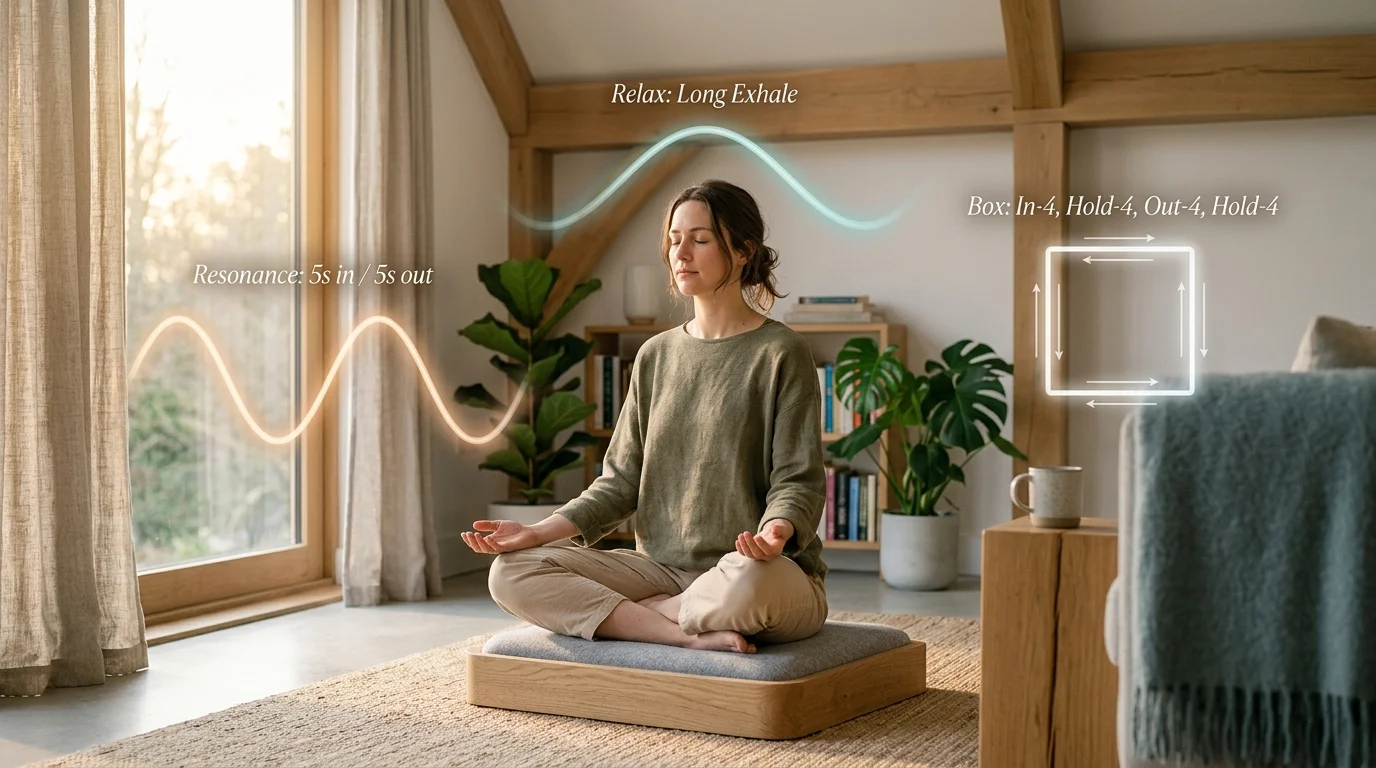
RE includes three dedicated breathing patterns designed for distinct nervous system states. Long-press the visualizer orb in the app at any time to switch between them.
Resonance
Inhale · Exhale (No Hold)Heart-rate synchrony and autonomic balance.
Daily nervous system regulation, cardiovascular resilience, and emotional steadiness without sedation.
Physiological Mechanism: Symmetric pacing aligns respiration with your natural baroreflex oscillation (~0.1 Hz), maximizing heart rate variability and vagal efficiency.
Relax
4s Inhale · 7s Hold · 8s ExhaleDeep parasympathetic brake and acute calming.
Evening wind-down, bedtime and insomnia, and rapidly down-regulating acute anxiety or sympathetic overdrive.
Physiological Mechanism: The extended breath retention followed by a prolonged 8-second exhale engages the vagal brake, lowering heart rate and signaling biological safety.
Reenergizing
4s In · 4s Hold · 4s Out · 4s Hold-OutCentered alertness and grounded focus under pressure.
Mental clarity, high-pressure preparation, breaking task paralysis, and clearing mental fatigue without agitation.
Physiological Mechanism: Four equal phases balance blood oxygen and carbon dioxide levels while stabilizing autonomic arousal for calm, focused readiness.
Calibration Guide: "The Light Touch"
Precision HRV measurement using a smartphone camera requires clean optical light capture. Follow these four calibration steps to ensure millisecond-accurate readings every time.
Choose your finger
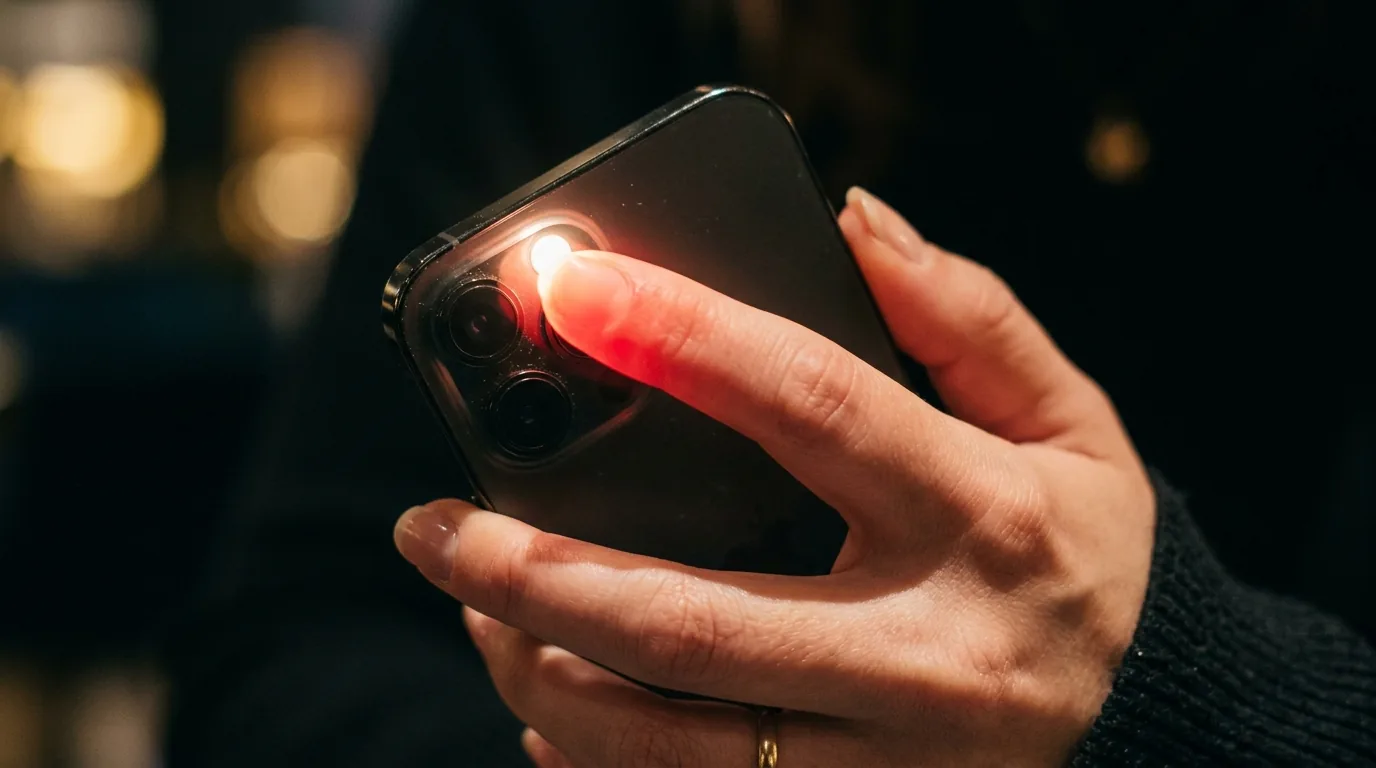
Use your Non-Dominant Index Finger (e.g., your left index finger if you are right-handed). The skin is usually softer and more sensitive, which allows the camera to see your pulse more clearly.
Sensitivity & Softness: Non-dominant fingertips have lower callousing, producing a higher signal-to-noise ratio for optical sensors.
The "ghost" touch
Don't press hard. If you press too firmly, you collapse the tiny blood vessels in your fingertip, and the signal will disappear.
The Goal:
Place your finger just barely touching the lens and flash. Imagine you are touching a bubble without popping it.
Microvascular Hemodynamics: Capillary blood flow stops under direct pressure. A feather-light touch allows full pulsatile volume shifts.
Finding the "sweet spot"
Fully cover the Camera Lens and the Flash.
Optical Uniformity: A solid red screen confirms even illumination across the camera sensor without light bleed.
Stay still (the 60-second rule)
Rest your hand on a flat surface (like a table) during the scan.
Artifact Prevention: Static arm resting prevents muscular tremor artifacts that skew RMSSD and peak-detection algorithms.
Warm hands before you scan
“My scan quality is low, or my Recovery looks unusually high.”
Nine times out of ten this is cold fingers. Warm your hands before scanning and let your breathing settle before trying again.
The camera reads your pulse as a very small change in brightness through your fingertip. When your hands are cold the blood vessels there narrow, and that signal nearly disappears. On the same phone minutes apart, a cold hand gave roughly a quarter of the signal a warm one did.
A weak signal does not just fail the scan. It makes your Recovery score read higher than it really is, because uncertainty in beat timing can only ever push that number up.
Other adjustments that help:
Scientific Research
The evidence base supporting RE methodology, including clinical studies on HRV, coherent breathing, and vagal tone.
[1] Effects of Diaphragmatic Breathing on Attention, Affect and Stress
Zaccaro, A., et al. (2015), Consciousness and Cognition
[2] The Effectiveness of Diaphragmatic Breathing Relaxation Training for Reducing Anxiety
Chen, Y. F., et al. (2017), Perspectives in Psychiatric Care
[3] What are the benefits of mindfulness? A practice review
Davis, D. M., & Hayes, J. A. (2011), Psychotherapy
[4] Noise improves cognitive performance in schoolchildren with difficulties
Söderlund, G., et al. (2007), Journal of Child Psychology and Psychiatry
[5] The Polyvagal Perspective
Porges, S. W. (2007), Biological Psychology
[6] Heart Rate Variability Biofeedback: A New Tool for Psychiatric Practice
Lehrer, P. M., et al. (2000), Applied Psychophysiology and Biofeedback
[7] Biofeedback, Resonance Frequency Breathing, and Heart Rate Variability
Lehrer, P. M., & Gevirtz, R. (2014), Biofeedback
[8] Brainwave entrainment for better sleep and post-sleep state of psychophysiological arousal
Abeln, V., et al. (2014), Sleep Medicine
[9] The Coherent Heart: Heart-Brain Interactions, Psychophysiological Coherence, and the Emergence of System-Wide Order
McCraty, R., & Childre, D. (2004), Integral Review
[10] The Effect of Short Duration Heart Rate Variability (HRV) Biofeedback on Cognitive Performance During Laboratory Induced Stress
Prinsloo, G. E., et al. (2014), Applied Psychophysiology and Biofeedback
[11] Heart Rate Variability Biofeedback with Asthma: A Randomized Controlled Trial
Lehrer, P. M., et al. (2007), Chest
[12] Characteristics of Resonance in Heart Rate Variability Stimulated by Biofeedback
Vaschillo, E. G., et al. (2006), Applied Psychophysiology and Biofeedback
[13] Heart Rate Variability Biofeedback Increases Baroreflex Sensitivity and Clinical Status in Asthma
Lehrer, P. M., et al. (2003), Chest
[14] Meditation experience is associated with differences in default mode network activity and connectivity
Brewer, J. A., et al. (2011), PNAS

Find your Flow?
Test the pre-release app
Join our closed alpha. Choose your platform below, enter your email, and we will send you the private install links. As a thank-you, you will receive free lifetime access to the app (limited to the first 34 testers).
Android & Smartwatches
Alpha channel for Google Android users and Android-compatible smartwatches.
iPhone & Apple Watch
TestFlight alpha channel for iPhones and Apple Watches.