At a Glance
- 01The Harmonic Chime offers pitch-guided pacing without needing stereo headphones.
- 02Binaural beats rely on dual frequencies to gently entrain brainwaves via headphones.
- 03RE provides 3 binaural modes: 3.2 Hz Delta (Sleep), 5 Hz Theta, and 7.8 Hz Schumann.
- 04Both acoustic anchors quiet mental effort to help your body shift into resonance.
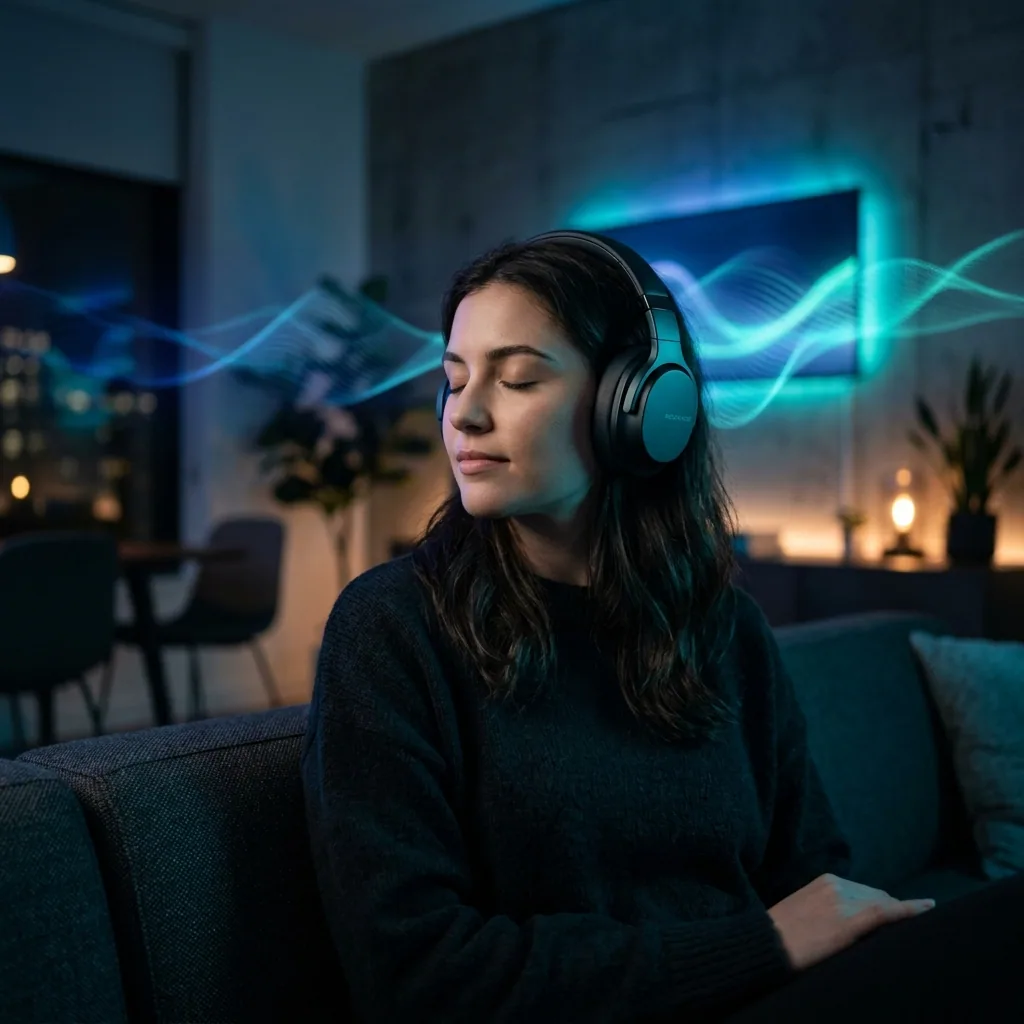
Sound is a direct shortcut to the human nervous system. Long before modern neuroscience mapped cortical entrainment, musicians knew it, contemplative traditions practiced it, and your body recognises it: a loud siren triggers immediate sympathetic vigilance, while steady rain pulling across a window induces calm.
At RE, we engineered our soundscapes around this biological truth. The busy mind requires an external sensory anchor to step out of its default loop of planning and overthinking. Auditory anchors give your attention something steady to hold while your autonomic system settles into 0.1 Hz resonance.
In the RE App Sensory Studio, you can select between two primary auditory anchors: the Harmonic Chime and Binaural Beats. Both guide you toward parasympathetic recovery, but they use fundamentally different acoustic mechanisms to get you there.
01. Harmonic Chime: the intuitive path of flow
If Binaural Beats act as a high-precision acoustic tuning fork for your brain, the Harmonic Chime is an organic, melodic guide. This soundscape is designed to feel natural and fluid, mirroring the smooth expansion and release of an ocean wave.
The Sonic Visualiser
The Harmonic Chime rises in pitch as you inhale and falls smoothly in pitch as you exhale. It acts as an auditory visualiser that keeps you locked to your 5.5-second inhale and 5.5-second exhale pace without ever needing to open your eyes or count in your head.
How it works
The chime generates smooth tonal transitions between high and low pitch pivots, encouraging a continuous, circular breath loop without breath-holding at the top or bottom of the cycle.
The benefit
It is exceptionally sensory-friendly. For individuals who find constant tones or mechanical frequencies over-stimulating, the Harmonic Chime provides a gentle, melodic entrance into parasympathetic downregulation.
02. Binaural Beats: neural entrainment
Binaural beats rely on an auditory illusion generated by the superior olivary complex in the brainstem, first described by Gerald Oster in 1973. When two slightly different pure tones play separately into each ear through stereo headphones, the central nervous system integrates the signals and perceives a third, phantom rhythmic beat equal to the mathematical difference between the two frequencies.
For example, if a 200 Hz tone is presented to your left ear and a 205 Hz tone to your right ear, your nervous system processes a 5.0 Hz binaural beat.
Auditory frequency entrainment
Through a process called Frequency Following Response (FFR), your cortical brainwaves begin to align their electrical firing rates with the perceived difference frequency. Research by Chaieb et al. (2015) indicates that at least 10 minutes of continuous entrainment is required to induce stable shifts in mood and autonomic tone.
03. Three target frequencies
In the RE App Sensory Studio, under Breathing Cues → Binaural Beats, you are not restricted to a single tone. You can select between three scientifically calibrated frequency presets to match the exact intention of your practice session:
3.2 Hz Delta: Deep Relaxation & Sleep
Delta waves (0.5 to 4.0 Hz) represent the lowest frequency spectrum of human brainwave activity, dominant during deep slow-wave sleep and physical restoration.
Best Used For: Evening wind-down routines, pre-sleep breathwork, and post-workout autonomic recovery when your goal is physical relaxation.
5.0 Hz Theta: Breathwork & Mindfulness
Theta waves (4.0 to 8.0 Hz) correlate with deep meditative states, somatic interoception, emotional regulation, and creative flow. In a 30-minute study protocol by Lane et al. (1998), theta entrainment measurably improved psychomotor vigilance and reduced negative mood states.
Best Used For: Daily Coherent Breathing sessions, seated mindfulness practice, and stepping out of analytical mental chatter into physical presence.
7.8 Hz Schumann: Earth Resonant Frequency
Sitting right on the boundary between Theta and Alpha (7.83 Hz), this frequency matches the fundamental electromagnetic resonance of Earth's ionosphere (the Schumann Resonance). Research by Söderlund et al. (2007) demonstrates that moderate background acoustic noise supports cognitive performance and attention through stochastic resonance.
Best Used For: Alert relaxation, daytime stress resets, grounded focus, and neurodivergent breathers seeking steady attention without drowsiness.
Which anchor is right for you?
Selecting your soundscape depends on your environment, your equipment, and the state you want to cultivate.
Harmonic Chime
Binaural Beats
Sound as a tool for resilience
Whether you choose the melodic flow of the Harmonic Chime or one of the three Binaural Beat frequency presets, the core objective remains the same.
By giving your attention a clear auditory anchor, you reduce the top-down cognitive effort required to meditate. You allow your body to take the lead. Over time, your nervous system learns to recognise these soundscapes as a familiar signal to shift out of high-alert stress and into deep autonomic resonance.
Explore the sensory studio
Open the RE App, open the Sensory Studio, and experiment with Chimes or the 3.2 Hz, 5.0 Hz, and 7.8 Hz Binaural presets. Discover which anchor shifts your nervous system fastest.
Download REScientific references & further reading
Important Note: This content is intended for informational and self-regulation purposes only. It is not a medical device and should not be used to replace professional medical advice, diagnosis, or treatment. Always seek the advice of your physician or other qualified health provider with any questions you may have regarding a medical condition.