At a Glance
- 01Breathing at 5.5 seconds (0.1 Hz) synchronises your heart rate, blood pressure, and breath.
- 02Cardiologists, aerospace labs, and yogis discovered this 10-second rhythm independently.
- 03Your exact resonant speed depends on your physical height and blood vessel length.
- 04RE's calculator estimates your ideal starting pace from your height and biological sex.
Breathing slowly helps, but breathing at your body's specific resonant frequency does something different altogether. Think of your cardiovascular system like a vintage radio. When you tune near a station, you hear music mixed with static. When you hit the exact frequency, the static drops out and the audio turns clear. In biofeedback, that exact frequency is your personal resonance.
01. The universal rhythm: 5.5 seconds in and out
Breathing at 5.5 seconds in and 5.5 seconds out targets a frequency of roughly 0.1 Hz. That pace is not arbitrary. It is the specific rate where cardiovascular oscillations and respiratory rhythm settle into single-frequency alignment.
Why it works
At 0.1 Hz, your internal "accelerator" (sympathetic) and "brake" (parasympathetic) stop fighting each other and start working as a team. This is what researchers call the baroreflex loop: the mechanism that couples your breath rate to your blood pressure and heart rate. Hitting resonance produces the largest possible swing between the two, which is what makes this specific pace so much more effective than "just breathing slowly."
Why cosmonauts, cardiologists, and yogis arrived at the same breath
It is rare in science to see Soviet aerospace labs, Western medical schools, and ancient yogic caves all pointing at the exact same spot. Soviet aerospace researcher Evgeny Vaschillo (2006) found that breathing near 0.1 Hz maximised cardiovascular efficiency in cosmonauts under G-force stress, a practical engineering fix rather than a relaxation exercise. Cardiologists map the same 10-second blood pressure oscillation as a Mayer wave. Yogis have practised Sama Vritti, equal-length inhale and exhale, for centuries, discovering the same steadying effect through feeling rather than biofeedback charts. None of these groups needed the others to find it: human physiology worked the same way regardless of the era or country.
02. Your resonant speed depends on your height
The 5.5-second rule is a solid starting point, but human bodies are not manufactured on an assembly line.
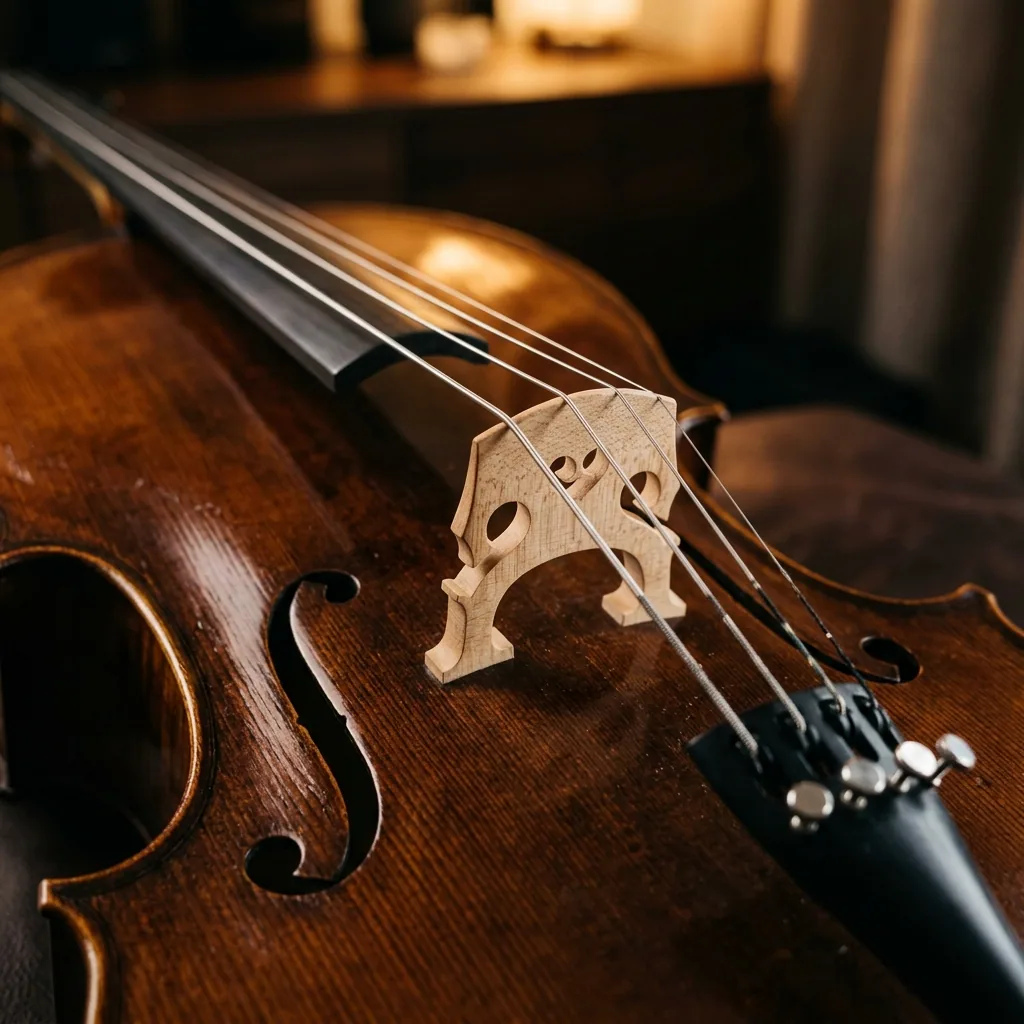
Think of your circulatory system like a musical instrument. A cello has longer strings than a violin and therefore vibrates at a deeper, slower frequency. Taller individuals have longer arterial pathways, meaning blood pressure waves take slightly longer to travel down the aorta and back. Because of that extra physical length, a taller person's resonant breathing pace naturally sits closer to 6.0 seconds per phase, while a shorter person's sweet spot might sit nearer 4.5 or 5.0 seconds.
You are not trying to force your body to fit a rigid number. You are simply tuning the instrument you were born with.
The zero-strain rule
Comfort is the golden rule. If a 5.5-second exhale makes you feel breathless or tense, your body shifts back into sympathetic stress and cancels out the benefit. Finding your cadence means choosing a smooth, effortless rhythm you can sustain without forcing. When you match your breath exactly to the speed of your blood pressure waves, you achieve "gain": your heart rate variability reaches its near-optimal peak, like pushing someone on a swing at exactly the right moment.
03. How to calculate your personal resonant speed
To make this practical, RE includes a Resonance Frequency Calculator that uses peer-reviewed regression equations to estimate your ideal rhythm from your physical build without requiring clinical monitoring.
The research formulas
The app converts that BPM figure into a pacer speed with a simple ratio: seconds per inhale/exhale = 30 ÷ breaths per minute. A resonant frequency of 5.3 breaths per minute, common for a man around 180 cm, becomes a pacer speed of roughly 5.7 seconds for both inhale and exhale.
- 1Calculate your baseline. Open the RE app, enter your biological sex and height in settings, and the pacer updates immediately.
- 2Do a comfort test. Breathe with the new pacer for 3 to 5 minutes. It should feel slow but comfortable. Air hunger means too slow; feeling rushed means too fast.
- 3Fine-tune in increments. Adjust the pacer from 4.5s to 6.5s in 0.1-second steps. Most people land within 0.2 seconds of the height-based estimate.
Once your pacer is set, the pre-session scan gives you a baseline to measure against. The numbers below show your autonomic state before breathing begins, so after you finish you can see whether your frequency actually moved the needle.
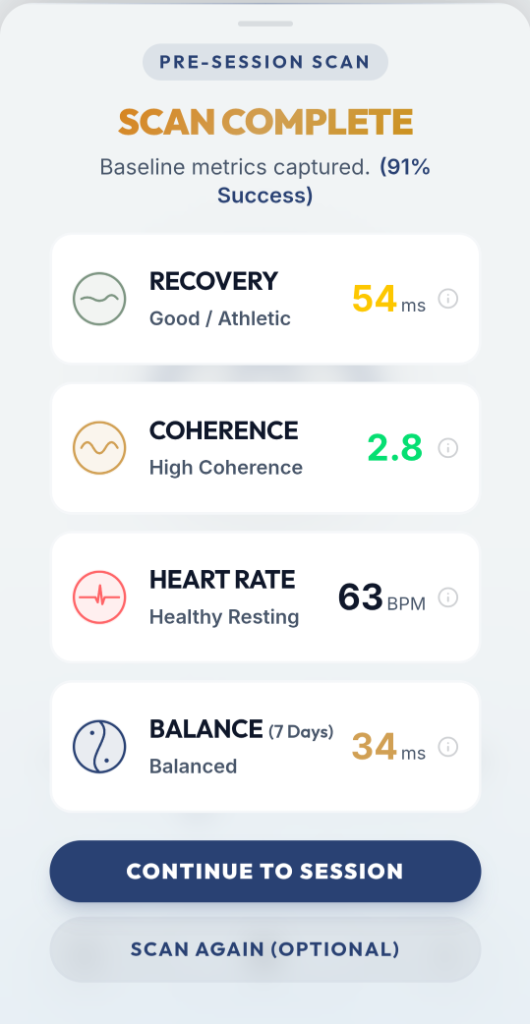
Pre-session scan in the RE app capturing your Recovery, Coherence, Heart Rate, and 7-day Balance baseline before a breathing session begins.
Practical tip: Do not obsess over finding your "perfect" number on day one. Start with the 5.5s baseline, get comfortable with the stillness, and once you can breathe for 10 minutes without trying, use the calculator to find your edge.
Daily practice strengthens your vagal brake over time
Most people do not live in quiet retreat centres or space labs. Answering notifications, sitting at screens, and absorbing small daily interruptions keep the nervous system in low-level alert, and over weeks that accumulates as chronic fatigue and mental friction. Hitting resonant pace sends a signal up through the vagus nerve, your heart telling your brain the body is safe. It also strengthens vagal tone over time, the way regular exercise strengthens a muscle, so you recover faster after a hard conversation or a stressful afternoon.
Try this the next time you sit down with the pacer: start at 5.5 seconds, and instead of adjusting the number, adjust your attention. Notice whether the exhale wants to run half a second longer before you change anything. Your body usually tells you before the calculator does.
The radio finds the station. The cello settles into its resonance. Neither one forces it. Both just need to be tuned correctly. That is all coherent breathing is: not a technique to master, but a frequency to find. Start at 5.5 seconds, stay long enough to listen, and let the number come to you.
Find Your Frequency
RE starts you at 5.5 seconds, the rhythm that works for almost everyone. From there, a simple height-based formula finds your precise frequency, removing the guesswork without clinical complication.
Find Your ResonanceScientific References & Further Reading
Important Note: This content is intended for informational and self-regulation purposes only. It is not a medical device and should not be used to replace professional medical advice, diagnosis, or treatment. Always seek the advice of your physician or other qualified health provider with any questions you may have regarding a medical condition.