
At a Glance
- 01Mindfulness is the attention control needed to notice your body's physiological signals.
- 02It dials down activity in the Default Mode Network (DMN), the brain network linked to rumination.
- 03The goal isn't a blank mind, but catching your attention when it drifts and bringing it back.
- 04It turns routine breathing exercises into active nervous system regulation.
The word "mindfulness" has been stretched so thin it barely holds its meaning anymore. Corporate wellness decks. App notifications reminding you to breathe. Instagram captions over stock photos of sunrises. At some point, the signal got lost in the noise.
Which is a shame. Because when you strip away the branding, what you're left with is one of the most practically useful skills a human being can develop, not as a philosophy, but as a physiological tool.
In the context of the RE app, we define mindfulness simply: it is the ability to notice where your attention has gone, and deliberately choose where to return it.
The science of "being here"
When left on autopilot, the mind rarely stays in the present. It loops through past conversations or plans for scenarios that haven't happened yet.
Brewer and colleagues linked this background chatter to the Default Mode Network (DMN). This network of brain regions lights up when you aren't focused on a specific task: daydreaming, worrying, or replaying memories. When the DMN stays continuously active, it tracks closely with anxiety, low mood, and a short attention span.
Tang, Hölzel, and Posner's review of the neuroscience literature shows that focused-attention practices quiet DMN activity. Over time, this changes how quickly you catch yourself spiraling and shift back to what is happening right now. It is basic neuroplasticity: you train your brain to become less reactive.
You don't need to stop thinking
A common mistake is assuming meditation means stopping your thoughts, and when thoughts keep coming, people conclude they aren't built for it. Having thoughts during practice is normal. Mindfulness is not about clearing your mind; it is about changing how you respond to what pops up. A classic metaphor compares awareness to the sky and thoughts to passing clouds: some heavy and dark, others light. The untrained mind chases every storm. A mindfulness practice helps you stay grounded as the observer. When you notice your focus has drifted, you name it neutrally ("that's a work thought") and bring your attention back to your breath without frustration.
Mindfulness meets RE
In the RE app, coherent breathing guides your heart rate and breath into sync. But maintaining that rhythm requires noticing the moment your focus drops. Without attention control, breathing exercises easily turn into rote repetition: you count the seconds but feel nothing shift. When you pair active awareness with rhythmic breathwork, you start noticing real physical changes: your stomach relaxing, your heart rate smoothing out, your shoulders dropping.
To support this, RE offers a number of mindfulness practices depending on whether you need voice guidance, physical body awareness, or quiet self-directed time.
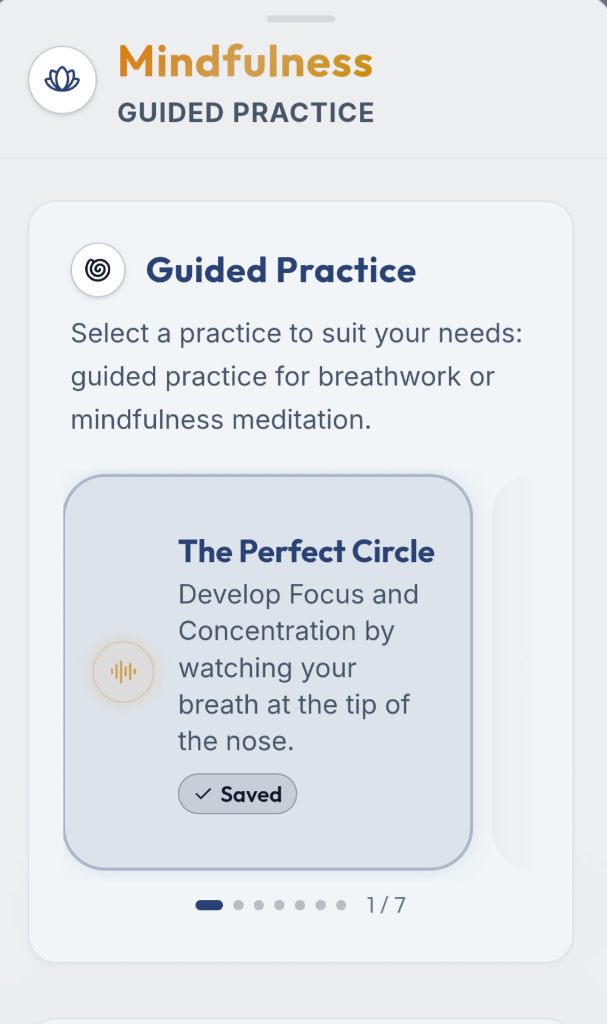
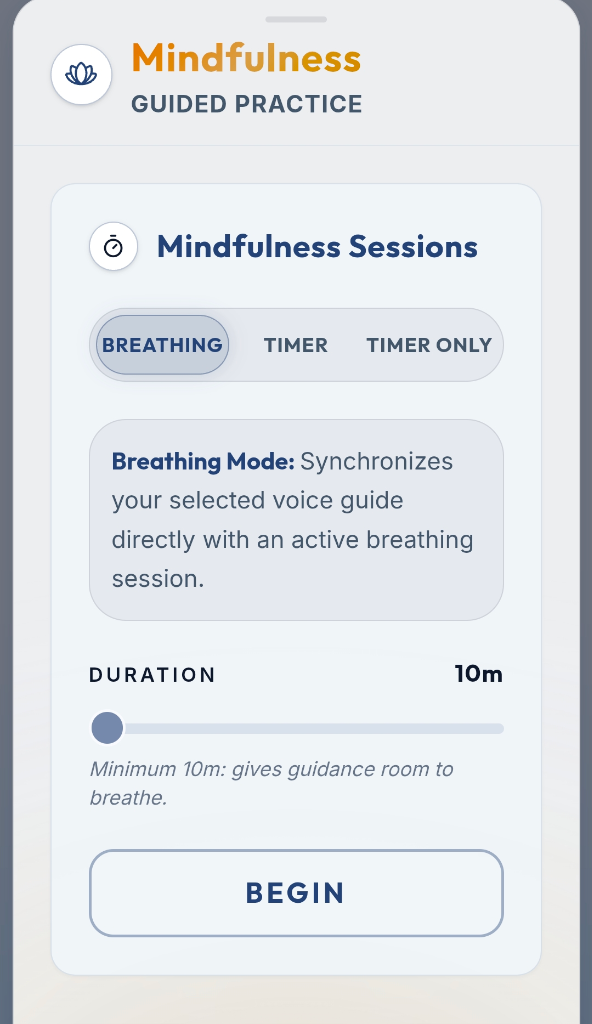
Examples of mindfulness practices and session modes in the RE app.
Example Guided Practice The Perfect Circle
Voice-guided journeys designed to develop focus and concentration by anchoring your attention to the tip of your nose. Streams directly into your session, using auditory cues to help you return to coherence whenever your focus drifts.
Breathing & Timer Modes Session Control
Flexibility to run sessions your way. Breathing Mode synchronizes your selected voice guide directly with an active breathing session and visualizer. Timer Mode pairs your guided voice with a silent meditation timer and interval bells.
Timer Only Mode Unguided Space
An unguided meditation space with interval bells and sessions from ten minutes up to an hour. Periodic ambient chimes act as quiet checkpoints to notice where your mind has wandered, without interrupting your flow.
Practicing these modes isn't about becoming good at sitting still. It gives you a way to step out of automatic stress responses before they take over. When you bring focus to your breathing, you move from passive exercise to active regulation. That's the thing underneath all the buzzword noise: a repeatable way to notice what your body is doing, and choose what happens next.
Finding your anchor
The RE app offers guided voice tracks, body-awareness sessions, and flexible meditation timers to fit your routine.
Try starting with a 5-minute session today while you are calm. That way, your body already knows the rhythm when stress builds up.
Download REScientific references & further reading
Important Note: This content is intended for informational and self-regulation purposes only. It is not a medical device and should not be used to replace professional medical advice, diagnosis, or treatment. Always seek the advice of your physician or other qualified health provider with any questions you may have regarding a medical condition.