At a Glance
- 01Works with any smartphone camera & flash, with no smartwatch or wearable required.
- 02Measures HRV (Heart Rate Variability), RMSSD, SDNN.
- 03Gives you a real-time "Coherence Score."
- 04No image or video ever leaves your phone: only a brightness number per frame.
No Smartwatch? No Problem.
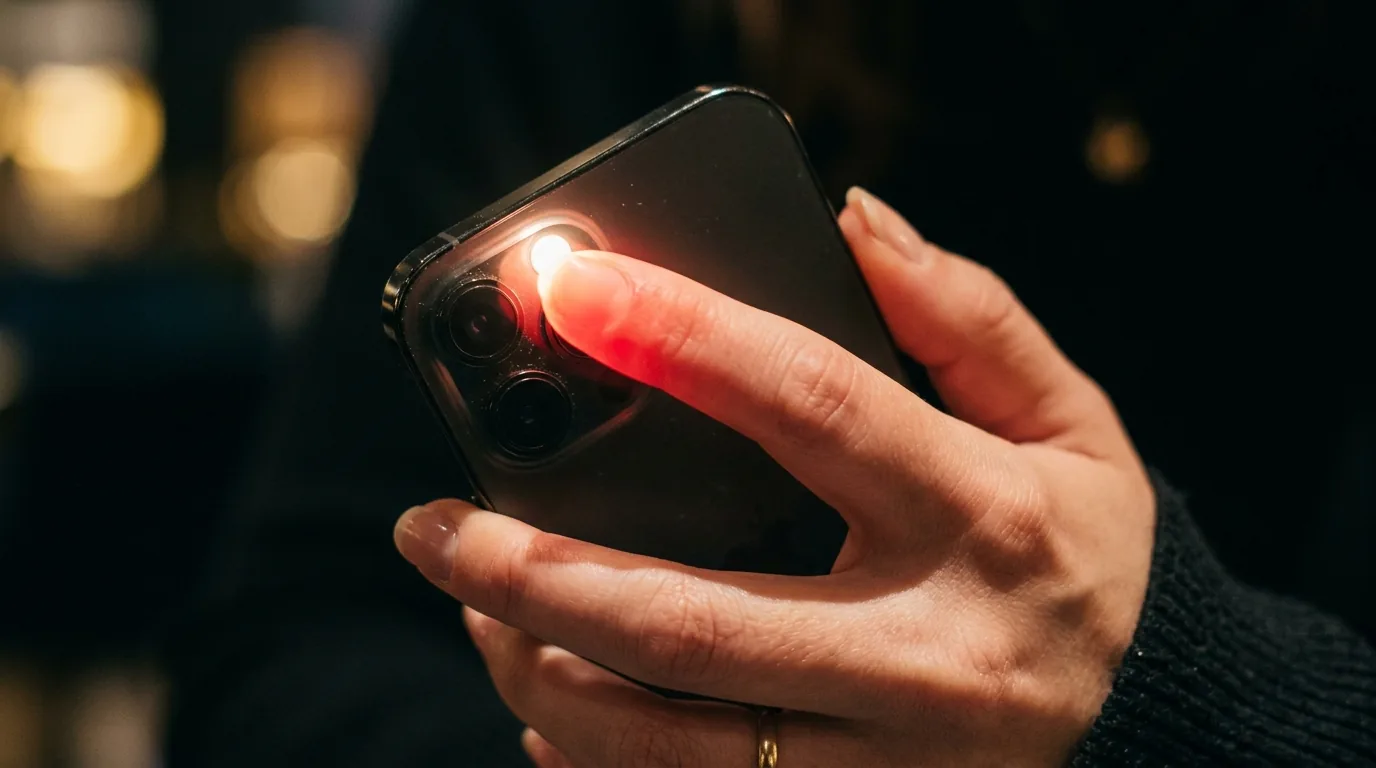
Unlike HRV monitors that require a chest strap, an Apple Watch, or a Garmin, the RE Heart Rate Scanner needs exactly one thing you already own: a smartphone with a camera and a flash. That's it. No extra hardware. No subscription device. No wearable to charge. Just place your fingertip over the lens and the app does the rest, delivering reliable HRV insights right on your screen in 60 seconds.
01 What is the scanner?
The technology behind the RE heart rate scanner is called Photoplethysmography (PPG). It is a mouthful, but the concept is beautifully simple. By using your phone's camera and flash, the app can detect the tiny volume changes in your microvascular bed. As your heart beats, blood flows into your fingertip, absorbing more light from the flash. Between beats, blood flows back out, absorbing less light. By tracking these subtle changes in light absorption, we can construct a precise map of your cardiac cycle.
By analysing these tiny volumetric changes at up to 120 frames per second, we can extract a clear picture of your current physiological state.
02 How to use the scanner
To take a scan, you simply place your index finger over your phone's camera lens and flash. The app will automatically begin calibration. Keep your finger steady and breathe normally. The scan takes 60 seconds. During this time, the app is not just measuring your beats per minute; it is measuring the micro-intervals between those beats to calculate your HRV.
03 Demystifying the metrics
Once your scan is complete, you’ll be greeted with a dashboard of your results. If terms like "Coherence" and "RMSSD" look like alphabet soup right now, don't worry. A quick breakdown of the key metrics:
RECOVERY: Vagal Tone (RMSSD)
The Root Mean Square of Successive Differences focuses specifically on short-term beat-to-beat changes, which are driven almost entirely by the vagus nerve.
Significance: RMSSD is your primary rest-and-recover pathway. Higher scores suggest a robust vagal response, indicating the body is recovering effectively from stress.
BALANCE: HRV (SDNN)
The Standard Deviation of Normal-to-Normal intervals measures the total variation in time between consecutive heartbeats over a set timeframe.
Significance: SDNN indicates the overall capacity of your heart to respond to environmental shifts. It captures the combined influence of both sympathetic and parasympathetic regulation.
Coherence Score
This measures the alignment of your cardiac and respiratory rhythms, calculated by assessing the spectral power density distribution in the LF band.
Significance: Reflects the degree of autonomic resonance. High coherence values indicate that baroreceptors (blood pressure), breathing cycles, and heart rhythms are tightly synchronised.
Heart Rate (BPM)
Beats Per Minute is the baseline speed of your cardiovascular system, the fundamental guide for basic metabolic activity.
Significance: A lower resting heart rate generally reflects cardiovascular efficiency and parasympathetic activity, while elevated rates point to stress or physical demand.
Under the hood: how it actually works
The numbers on your results screen aren't estimates or approximations; they're the output of a multi-stage signal processing pipeline running in real time. Understanding what's happening behind the scenes makes those metrics considerably more meaningful.
01 The optical sensor (front-end)
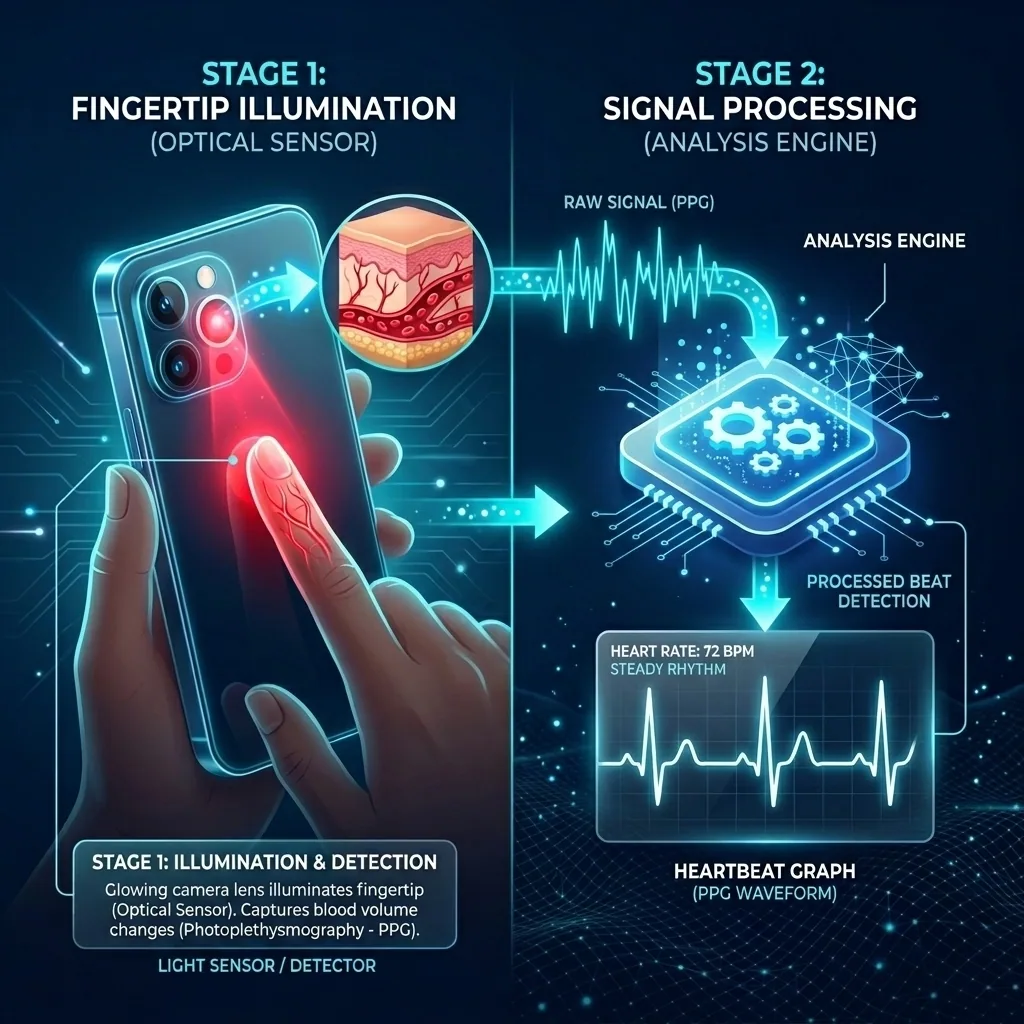
When you place your finger over the camera and flash, the app transforms your phone into a high-precision optical sensor:
- Transmissive PPGThe LED flash illuminates the deep microvascular bed of your fingertip, and the camera captures the transmitted light. As arterial blood pulses through your capillaries with each heartbeat, it modulates the light passing through to the sensor.
- Red-Channel Focus & Exposure LockingRed light (~660nm) penetrates deep tissue with the highest signal-to-noise ratio. The scanner locks white balance and dynamically tunes exposure to prevent the camera from over-saturating or hunting for focus mid-scan.
- Hardware Frame-Clock PrecisionHRV requires true millisecond precision. Every frame is stamped directly with hardware presentation timestamps from the camera pipeline, eliminating main-thread JavaScript scheduling jitter.
02 The analysis engine (back-end)
Raw optical signals contain motion and respiratory drift. Our backend uses clinical signal processing to extract authentic HRV:
- Adaptive Fundamental BandpassInstead of a rigid filter that can get confused by secondary dicrotic notches, the engine estimates the true fundamental heart rate from the frequency spectrum and adaptively filters noise without clipping real cardiac dynamics.
- Shape-Preserving Resampling (PCHIP)The signal is resampled to 180Hz using monotonic Piecewise Cubic Hermite Interpolating Polynomials. Unlike standard cubic splines, PCHIP never overshoots noisy samples or invents false peaks.
- Systolic Onset Fiducials & Parabolic RefinementTraditional algorithms measure the broad top of the pulse, where camera flash saturation causes timing errors. We detect the sharp systolic onset (trough) at the base of the pulse wave and fit continuous sub-sample parabolas, delivering sub-millisecond beat timing that is completely immune to flash clipping.
- Contiguous Normal-to-Normal (NN) MathSuccessive beat differences are computed strictly between adjacent, verified beats per clinical HRV standards. This prevents dropped beats from artificially inflating Recovery scores, ensuring reliable agreement with medical-grade sensors.
Science in the palm of your hand
By translating complex optical data into millisecond-accurate metrics, the RE Heart Rate Scanner bridges the gap between laboratory equipment and your daily routine. Understanding your autonomic state shouldn't require expensive wearables or medical visits. A sixty-second check-in gives you clear, objective feedback so you can see how your nervous system is actually responding to your practice.
Tune in to your body
Don't guess how your nervous system is doing. Let the RE Heart Rate Scanner show you the objective truth of your physical state in just 60 seconds.
No smartwatch. No wearable. Just your phone.
Try the ScannerScientific References & Further Reading
Important Note: This content is intended for informational and self-regulation purposes only. It is not a medical device and should not be used to replace professional medical advice, diagnosis, or treatment. Always seek the advice of your physician or other qualified health provider with any questions you may have regarding a medical condition.
To ensure the highest possible data quality, please ensure you allow for at least 60 seconds of uninterrupted stillness during your scan. While smartphone-based PPG technology is remarkably accurate as a guide for coherence training and trend tracking, it is naturally limited by hardware compared to clinical-grade medical equipment.