At a Glance
- 01The vagus nerve is the main communication highway connecting the brain and internal organs.
- 02It acts as your physiological reset button to trigger parasympathetic recovery and calm.
- 03Higher vagal tone supports faster recovery from stress and stronger emotional stability.
- 04Coherent breathing offers a proven, direct technique to tone and strengthen the nerve.
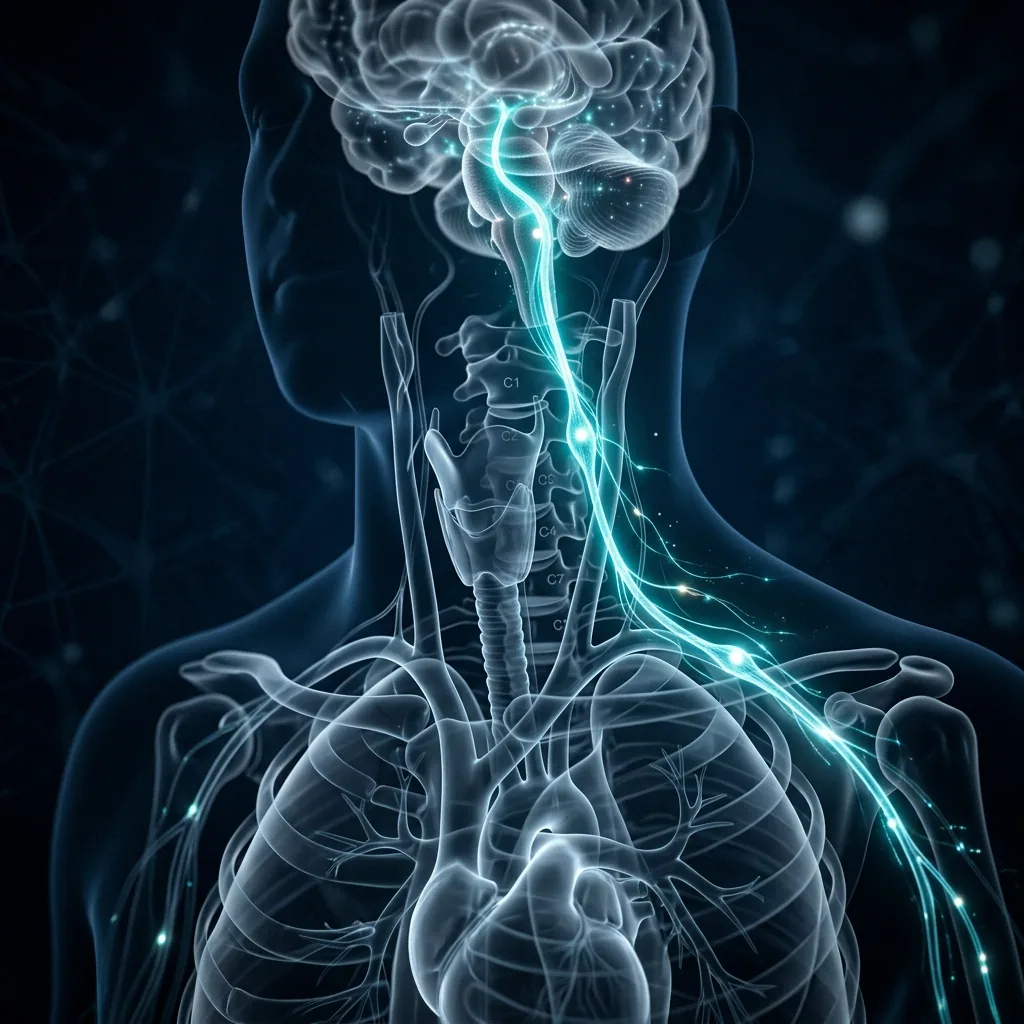
Right now, as you read this, a nerve is quietly wandering through your body. From your brainstem, down through your neck, weaving past your heart, threading through your lungs, and reaching all the way into your gut. It touches almost every major organ along the way. The Romans, with characteristic efficiency, simply called it vagus: the wanderer.
Most people assume the brain runs the show. They think it sends commands downward and the body simply obeys. The reality, backed by modern neuroscience, is far more interesting: roughly 80% of the fibres in your Vagus Nerve carry information from the body to the brain, not the other way around. Your peripheral organs are constantly sending status reports upstairs to the brainstem. This is why trying to "think your way" to calm so often fails. The signal has to go through the body first.
Why Modern Stress Gets Trapped in Your Body
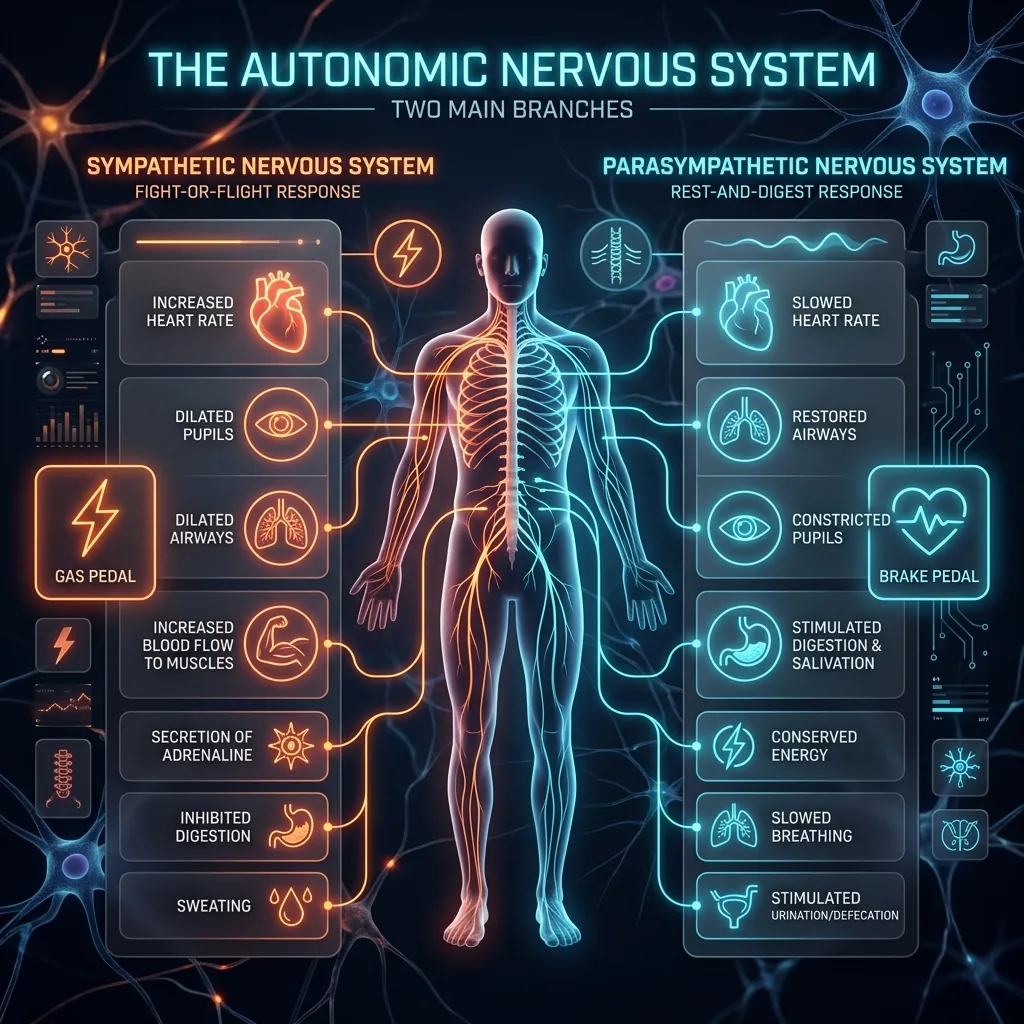
Figure 1: The sympathetic and parasympathetic branches of the autonomic nervous system.
Your Autonomic Nervous System is responsible for everything your body does without you thinking about it: heart rate, digestion, and immune response. It operates through two primary branches that act like the pedals of a car:
The Sympathetic Nervous System
(The Gas Pedal)This is your "Fight or Flight" system. It floods your body with cortisol and adrenaline to prepare you for action. While useful for survival, chronic activation leads to burnout and anxiety.
The Parasympathetic Nervous System
(The Brake)This is your "Rest and Digest" system. Its job is to slow things down, facilitate healing, and return the body to a state of balance.
In a healthy system, these two branches function in a state of responsive balance. However, modern life often keeps our foot glued to the gas pedal.
The stress response evolved for threats that end. Sprint from the predator, the predator is gone, cortisol drops and the body resets. A difficult conversation at work never ends that cleanly. A deadline folds into the next one. The nervous system escalates but has nothing to resolve against, so it stays up. That is the trap: a physiology built for short, decisive threats running continuously against problems that don't have a finish line.
You know the feeling. You finish a stressful meeting and can't quite shake the tension for the rest of the afternoon. You lie in bed with a mind that won't stop processing. You snap at something small and wonder why your threshold is so low. This is not a character flaw. It is physiology. Your nervous system is stuck in a high-activation state, and without a deliberate signal to shift gears, it will stay there.
80% of vagal signals flow upward from body to brain
This wandering nerve is the primary biological "cable" of the Parasympathetic Nervous System. It is the physical pathway that allows your body to communicate calm directly to your brain.
Why "Bottom-Up" Works
Because the Vagus Nerve is predominantly a sensory channel, your physiology is essentially talking to your brain all the time. A racing heart tells the brain: "we are in danger." A slow, rhythmic pulse tells the brain: "we are safe." Coherent Breathing exploits this channel deliberately, sending a calm, ordered signal upward, and letting the brain update its threat assessment accordingly. You are not tricking your mind. You are giving it better data.
Vagal tone and resilience
Scientists use a metric called Vagal Tone to measure the health of this system.
High vagal tone is associated with:
- Increased Heart Rate Variability (HRV): Greater beat-to-beat flexibility reflecting strong autonomic recovery (Laborde et al., 2017).
- Better emotional regulation and executive control: Enhanced prefrontal cortex dampening of amygdala threat responses (Thayer & Lane, 2000).
- Reduced systemic inflammation: Suppression of pro-inflammatory cytokine production through the cholinergic anti-inflammatory pathway (Koopman et al., 2016).
- Lower blood pressure and improved digestion: Downregulated sympathetic vascular resistance and activated enteric gastrointestinal function (Porges, 2007).
Most people are walking around with chronically low vagal tone without realising it. The signs are subtle: a slow recovery time after stress, a background hum of anxiety that never quite resolves, difficulty settling the mind, a gut that reacts to tension before the brain has even registered it. None of these feel catastrophic on their own. That is precisely what makes them easy to normalise and hard to address.
The good news is the Vagus Nerve responds to training. It can be strengthened through intentional practice, and the effects show up in measurable ways.
Seeing your vagal tone in real time
While there are many ways to engage the vagus nerve, the challenge with traditional breathwork is that you rarely get objective feedback on whether your nervous system is actually responding.
The RE app changes this by giving you a direct window into your physiological response before and after every session. Using your smartphone camera lens or smartwatch, the app captures your baseline before you begin and measures your autonomic state immediately after you finish.
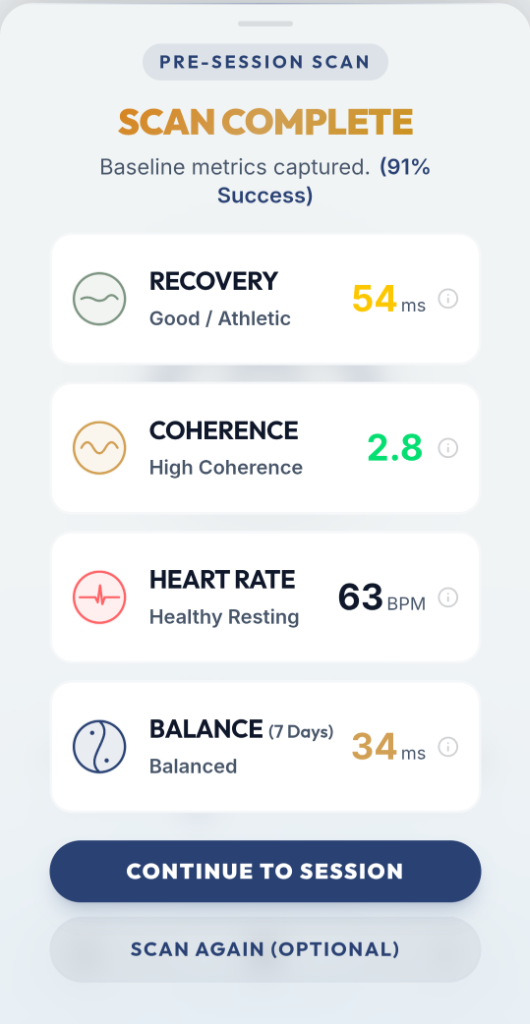
Pre-session scan results in the RE app, showing baseline recovery, coherence, heart rate, and 7-day autonomic balance before a breathing session begins.
The recovery metric: measuring vagal tone
The primary number that tracks vagal activation is your Recovery score, measured in milliseconds of RMSSD (root mean square of successive differences). The scan above shows a pre-session baseline of 54 ms, rated Good / Athletic. That reading is captured before the session begins, so you have an objective starting point rather than a feeling.
The other metrics fill out the picture. Coherence measures how ordered your heart rhythm is at rest. Heart Rate gives context for where your nervous system is idling. Balance tracks your 7-day autonomic trend rather than just the moment you scanned. Together they tell you whether your nervous system is primed for a session or running on empty before you've even started breathing.
When your vagus nerve engages during practice, it applies a direct physiological brake, increasing beat-to-beat variability. Scanning before and after means you can see that shift in the numbers rather than just guess at it.
The wanderer within you does not need to be a mystery. By understanding the path it travels, we begin to see that our stress and calm are not just mental states, but physical channels. Every slow, timed exhale is a direct conversation with your heart, your lungs, and your brain. It is the simplest, most natural way to take the wheel of your own autonomic nervous system. The next time you feel the gas pedal of modern life starting to stick, remember that the quiet wanderer is always ready to guide you back.
Reclaim Your Calm
You don't have to be a victim of your stress response. By weaving together the science of the nervous system with the practice of regulated breathing, you can take control of your internal state.
Strengthen Your Vagus NerveScientific References & Further Reading
Important Note: This content is intended for informational and self-regulation purposes only. It is not a medical device and should not be used to replace professional medical advice, diagnosis, or treatment. Always seek the advice of your physician or other qualified health provider with any questions you may have regarding a medical condition.