
At a Glance
- 01Neural pathways strengthen through daily practice to form lasting autonomic resilience.
- 02Breathing at 0.1 Hz builds a reliable default path for regulating acute stress.
- 03Bottom-up bodily signals quiet autonomic arousal faster than willpower alone.
- 04Consistent breathwork expands insular grey matter to sharpen body awareness.
For a long time, the common assumption was that calm required cognitive discipline: control your thoughts, manage your reactions, choose a different perspective. That model functions reasonably well under mild stress.
The limitation appears when acute stress arrives: the rational prefrontal cortex is typically the last network to engage during sympathetic arousal.
Neuroscience demonstrates that the adult brain is not a static organ. Through neuroplasticity, neural circuits continuously reorganise in response to repeated sensory and autonomic signals. The fastest, most reliable input you can send to your central nervous system does not originate in analytical thought. It originates in your breath.
From experience
I first encountered this idea at a meditation retreat. At the end of one session, the teacher recommended a book: Norman Doidge's The Brain That Changes Itself.
The core idea is almost confrontationally simple: the brain is not fixed. At any age, we grow new neurons. Old patterns can be replaced with new ones. The anxious loops, the reactive defaults, the stress settings I had spent years managing were trainable. Neuroplasticity shifted from a clinical term into something personal and actionable. It reframed everything in my practice, not as stress management, but as genuine structural change. That understanding is woven into how I built RE.
What is neuroplasticity?
Neuroplasticity is the brain's ability to change in response to experience. The neural pathways you use most frequently become stronger and faster, while the ones you use less often begin to fade.
"Neurons that fire together, wire together." (Carla Shatz, summarizing Hebbian Theory, 1992)
But the same mechanism works in reverse. Practice slow, resonant breathing often enough and the brain starts defaulting to a calmer baseline.
Rewiring from the bottom up
Most people think of rewiring the brain as a top-down mental task: trying to think positive thoughts or analyse behaviour. While valuable, top-down reframing can be difficult when your body is in sympathetic flight-or-fight.
Mindfulness & Breathwork offer a bottom-up approach to neuroplasticity. When you breathe at a slow, resonant pace (specifically an inhale for 5.5 seconds and an exhale for 5.5 seconds, forming an 11-second cycle at 5.5 breaths per minute), you send a rhythmic, high-fidelity signal through the vagus nerve directly to the brain.
The 0.1 Hz signal
Breathing at your resonant frequency (see Coherent Breathing 101 for the full mechanism) synchronises heart, lungs, and blood pressure into a unified 0.1 Hz wave. Research led by Mather and Thayer (2018) shows this resonance strengthens functional connectivity between the medial prefrontal cortex and the amygdala, dampening high-frequency anxiety noise so the brain can enter a more plastic, receptive state.
Strengthening the vagal brake
Every time you practice mindfulness and breathwork, you exercise your vagus nerve. Much like physical training, the more you engage the vagal brake to pivot from sympathetic arousal into parasympathetic recovery, the stronger that connection becomes. Over time, your brain returns to calm faster after a stressful event. That faster return is what resilience actually is.
Improving interoceptive accuracy
Neuroplasticity also applies to how accurately you perceive internal signals. A landmark MRI study by Hölzel et al. (2011) tracking an 8-week mindfulness program (averaging 27 minutes of daily practice) documented grey matter density increases in the left hippocampus, posterior cingulate cortex, and temporoparietal junction. Structural MRI data by Lazar et al. (2005) demonstrated 0.1 to 0.2 mm greater cortical thickness in the insula among regular practitioners, allowing you to catch stress before it escalates.
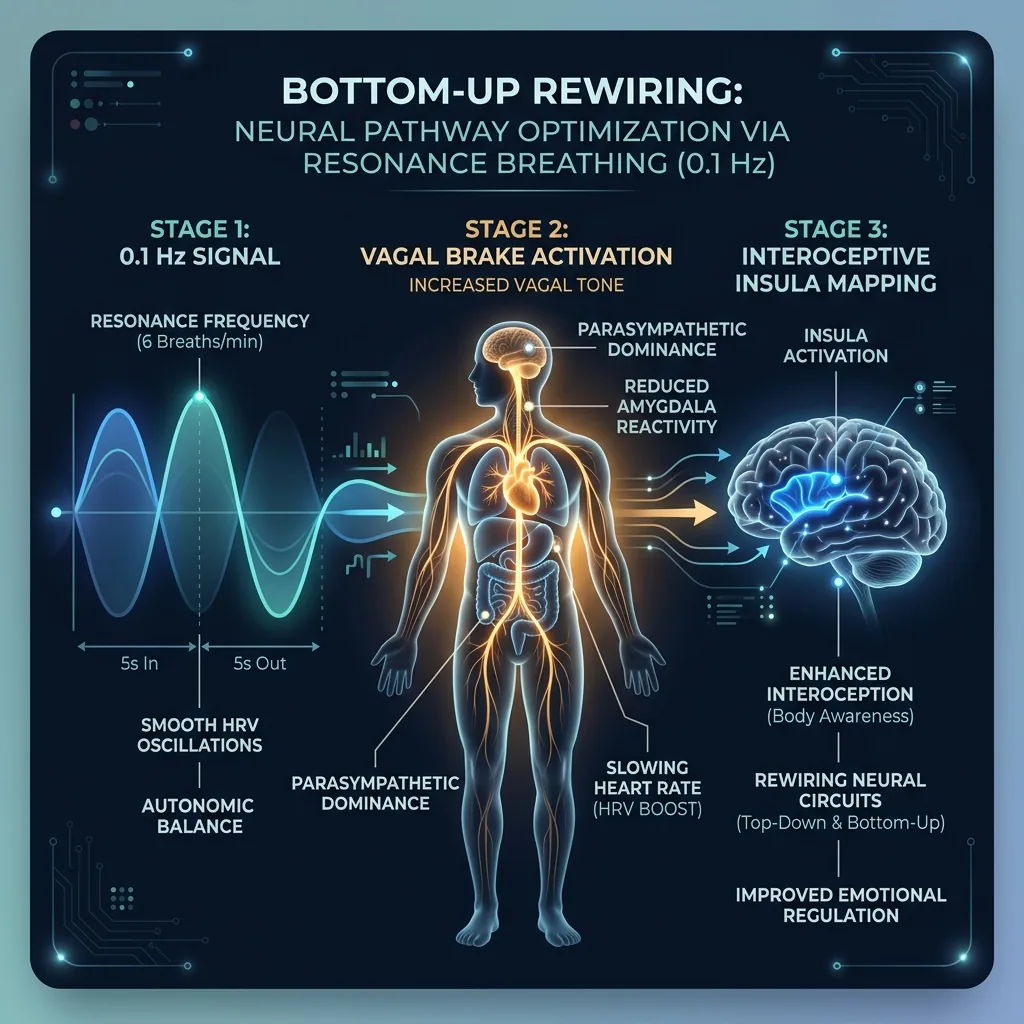
Figure 1: The three-stage Bottom-Up Rewiring process driven by mindfulness and breathwork.
The therapeutic dose: how to make the change stick
Neural change requires what researchers call a therapeutic dose.
Science suggests that just 10 minutes of practice creates an immediate "state effect", shifting your nervous system into a coherent rhythm and providing acute relief from stress. Expanding your practice to 20 minutes daily fosters a lasting "trait effect", resetting your baseline and creating a carry-over effect that maintains coherence for up to 24 hours.
Three practical principles for building autonomic resilience
- Consistency over intensityPracticing for 10 to 20 minutes daily builds stronger neural pathways than a single 70-minute session once a week. The brain requires frequent, repetitive signals to reorganise.
- Use theta statesThe RE app incorporates 5.0 Hz Theta Binaural Beats. Theta waves correlate with deep relaxation and synaptic plasticity, acting as a neural facilitator for the changes guided by your breath.
- Master the continuous loop (sinusoidality)Make the transition between inhale and exhale continuous. Eliminating pauses creates a smooth sine-wave pattern in heart rate variability, delivering a clear signal of order to central neuroplastic networks.
The research does not require a leap of faith. Grey matter changes are measurable. Vagal tone responds to training the way muscle tissue does. What the science establishes, and from what I understand in my own practice building the app, is that the capacity for calm is not a personality trait you either have or don't. It is a skill, built session by session through a signal as straightforward as your own breath. The nervous system you have tomorrow is shaped, in part, by what you do today.
Reclaim Your Brain
You are not stuck with the nervous system state you have today. The mechanisms for change are already running. Give them something to work with.
DOWNLOAD REScientific References & Further Reading
Important Note: This content is intended for informational and self-regulation purposes only. It is not a medical device and should not be used to replace professional medical advice, diagnosis, or treatment. Always seek the advice of your physician or other qualified health provider with any questions you may have regarding a medical condition.