
At a Glance
- 01ADHD burnout is autonomic dysregulation with low HRV, which passive rest rarely fixes.
- 02Silent meditation asks the executive mind to force quiet, creating mental friction.
- 03Bottom-up regulation uses sound and tactile haptics to settle the body first.
- 04RE's Sensory Studio provides physical anchors for minds that find silence difficult.
Prior to my diagnosis, my history was defined by a recurring cycle of inexplicable burnout. Without a label for the experience, these events simply repeated, each failure carrying a greater weight because the underlying mechanism remained hidden.
The depletion is specific; it lacks the linear progression of typical fatigue. Instead, it manifests with the suddenness of a tripped breaker. One day the system is running hot, chasing the next task before the last one finishes, then crash. Not resting or exhausted, but crashed the $(#& out. The difference matters, because rest implies recovery, and what actually happens is closer to a nervous system that has run past its margins and shut down the non-essential systems to survive. The nervous system has exhausted its physiological margins and retracted to essential functions only.
The metaphor I keep returning to is a car with its RPMs pinned. Revving all day, every day, with no clear start or finish, burning fuel at a rate the engine was never designed for. The ADHD nervous system does not have a faulty engine. It has a throttle with no resting position.
Burnout in this context is not a character flaw and it is not a productivity problem. It is a physiological event, and the HRV and cortisol data below back that up.
The biology of running hot
The short version is that the stress system gets stuck in the on position and the recovery system cannot keep up. Every time it fires there is a cost, and the cost does not get paid off before the next demand arrives. Eventually something gives.
Bruce McEwen gave that accumulation a name in the early 1990s: allostatic load.[1] The systems doing the firing, the HPA axis and the sympathetic nervous system among them, are working exactly as designed. They exist to mobilise the body under threat. The damage is not a malfunction as such. It is the bill for running them constantly, and McEwen called the point where the bill comes due allostatic overload.
For people with ADHD, that overload can sometimes be seen as closer to the baseline. Bellato and colleagues reviewed the evidence on autonomic function in ADHD in 2020 and found a consistent association with reduced heart rate variability,[2] the biomarker that reflects the balance between sympathetic activation and parasympathetic recovery—lower HRV. The system spends more time mobilising and less time restoring. The vagal brake, the parasympathetic mechanism that should slow everything down,[5] is weaker or less responsive.
The effects of this are not abstract. Elevated cortisol, a startle response set too high, and real difficulty getting from one task to the next. It is a nervous system that treats ordinary demands as emergencies, because the threshold for what counts as an emergency has been calibrated too low. At my worst, the smallest social demand would do it. Replying to a friend’s message could trigger a full fight-or-flight response.
There is also a cost that never shows up as output. Masking, the continuous effort of appearing regulated, attentive and unbothered when you are none of those things, is work the nervous system performs all day without producing anything visible at the end of it. It is allostatic load with nothing to show for itself, which is part of why ADHD burnout so often arrives alongside the feeling of having achieved nothing while being completely spent.
The one genuinely hopeful finding in this literature is that the brake responds to training. Lehrer and colleagues showed in 2003 that the baroreflex can be strengthened through deliberate resonant-frequency practice.[4] I will come back to that.
Why rest does not fix it
This is the part that confused me for years, and it confuses most people living through it. ADHD burnout does not respond to rest the way ordinary fatigue does. A weekend off can feel actively worse, because the ADHD brain without stimulation does not settle. It spirals. Removing external structure removes the scaffolding that was holding the dysregulated system together, and what emerges is not peace but a formless, buzzing agitation that is hard to name and harder to escape.
I could take time off and do everything right, and my nervous system simply would not reset.
That is not a discipline problem. Lennartsson, Jonsdottir and Sjörs found in 2016 that people with clinical burnout show persistent autonomic dysregulation even after extended sick leave.[3] HRV stayed suppressed, cortisol rhythms stayed flattened, and recovery took far longer than anyone expected. “Take a break” assumes the nervous system already knows how to stand down. Mine did not. It had to be shown what downregulation feels like, from the body up, before it could produce that state on its own.
Sleep deserves its own mention here, because overnight is when most of the repair is supposed to happen. Delayed sleep phase is common in ADHD. The drive to sleep arrives late, the evening is often the first point in the day when focus becomes available without a fight, and the window shrinks at exactly the stage of the cycle when the parasympathetic branch does its work. From there the two problems feed each other: a nervous system that cannot downregulate struggles to fall asleep, and a night that starts at 02:00 leaves less capacity for the day that follows. If the crashes keep coming despite everything else, sleep timing is usually the first place to look, and what the nervous system does overnight is worth understanding on its own terms.
Why “just sit quietly” backfires
The standard advice for a stressed mind is straightforward: sit quietly, close your eyes, clear your thoughts. For a lot of people that works. For a lot of neurodivergent people, including many with ADHD or autism, being told to sit still in silence is like an obstacle course with no ending.
The reason that most types of normal relaxation techniques ask the most tired part of the brain to do more work. It relies on the prefrontal cortex to filter background noise, hold an intention, and override the urge to move. That is top-down regulation, and it is a fair thing to ask of a brain with capacity to spare. In burnout there is none to spare. Demanding quiet through willpower produces friction rather than calm.
Bottom-up regulation goes the other way. Instead of the mind forcing the body into stillness, the signals start in the body: the pace of the breath, the movement of the diaphragm, the slow oscillation of blood pressure. Those travel up through the vagus nerve into the brainstem and the limbic structures, and the body tells the brain it is safe before the prefrontal cortex has to negotiate anything.[6]
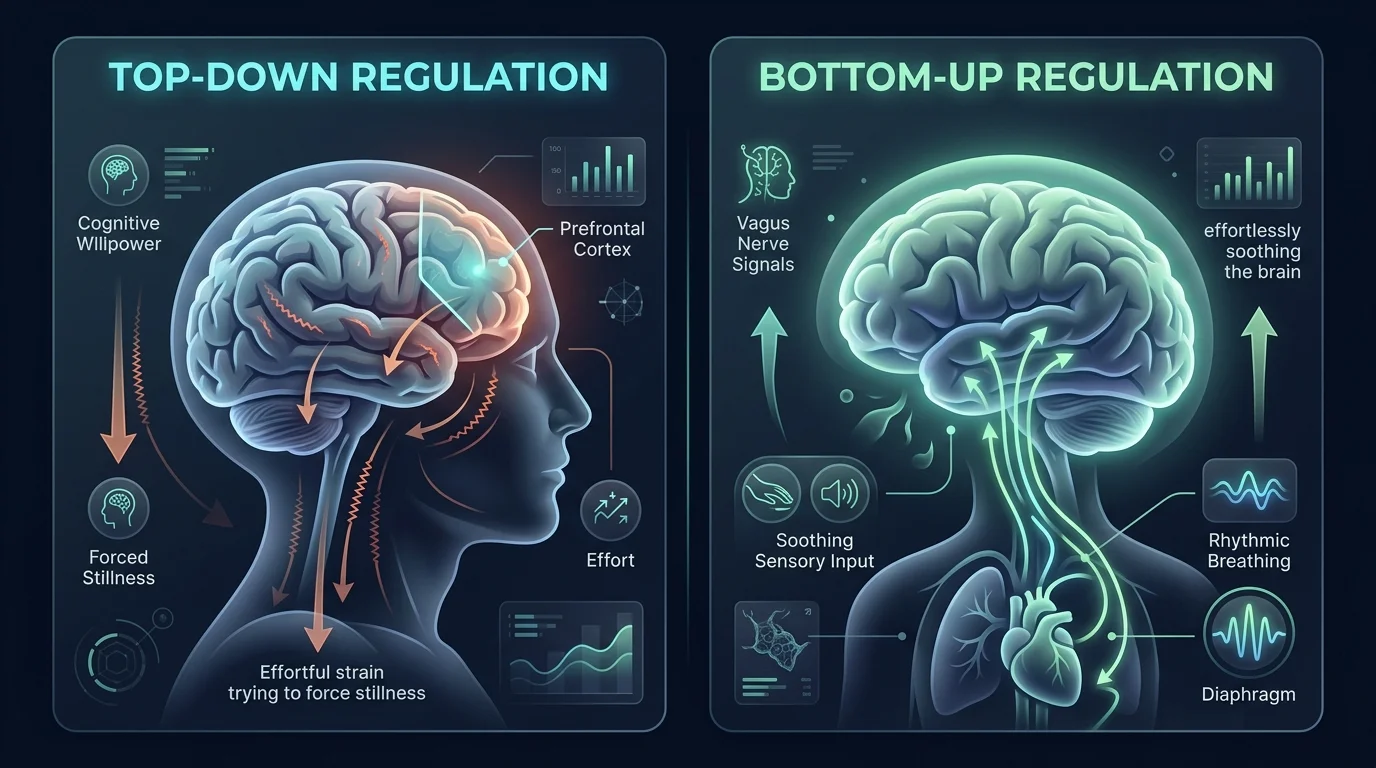
Top-down regulation forces stillness through cognitive willpower and prefrontal strain, while bottom-up somatic regulation uses physical rhythms and sensory anchors to signal safety directly to the brain.
The difference shows up most clearly when there is nothing to hold onto. A nervous system that is under-stimulated or hyper-vigilant reads silence as ambiguity, then fills the gap with racing thoughts or physical restlessness. Structured, rhythmic breath gives it a task instead. When there is something physical to track, the mind quiets as a side effect rather than as the goal.
If you have tried traditional silent meditation and felt like you were bad at it, consider that the method may simply have been mismatched to your neurology, not a verdict on your discipline.
The burnout cycle and how to interrupt it
ADHD burnout tends to follow a recognisable pattern. First a period of high output, often driven by hyperfocus, deadline pressure, or the dopamine reward of novelty. Then the crash: executive paralysis, emotional flatness, physical exhaustion, or all of it at once. This phase is not recovery. It is a shutdown. Then a recovery period that takes far longer than what most people expect.
Trying to force the return to baseline through willpower only deepens the depletion, and each iteration lowers the threshold for the next episode. The allostatic load accumulates, the HRV baseline drifts lower, and the crashes get longer and more severe.
Interrupting the cycle does not require giving up the high-output periods, which for many people with ADHD are when they feel most capable and alive. What it requires is actively downregulating during and after those periods, instead of waiting for the crash to force it. That is where somatic anchors found in the app earn their place: the maintenance that keeps the load from reaching system failure.

Interrupting the cycle means downregulating on purpose, rather than waiting for the crash to do it for you.
Somatic anchors in practice
Internal visualisation, or counting seconds in your head, adds another layer of cognitive load, and cognitive load is the thing that has already run out. So the anchor has to be external. That is the reason RE’s Sensory Studio leans on multi-sensory anchors rather than a visual timer alone.
Binaural beats
Two slightly different tones played through headphones create a phantom beat your brain locks onto, gently steering brainwave activity. RE offers three presets: Delta, Theta, and Schumann, compared in detail in Harmonic Chime vs. Binaural Beats.
Coloured noise
Brown, pink, or green noise and soft harmonic soundscapes give a brain that finds silence under-stimulating something clean to hold onto instead.
When your hands feel the rhythm and your ears hear the pace, the nervous system no longer has to work to stay anchored. The external cues hold the structure for you, so the practice does not demand concentration in the conventional sense. There is nothing to visualise and nothing to remember. The prefrontal cortex, already overtaxed, gets to follow instead of lead.
A brake for a system that never had one
There is a temptation, writing about ADHD and burnout, to promise that the right tool fixes it: that a breathing practice eliminates the crashes, or the right noise profile makes focus effortless. That would be dishonest.
What the research supports is more modest and more useful. The autonomic nervous system can be trained. HRV is not fixed. It responds to consistent practice the way any other feedback mechanism does.
It is also worth separating ADHD burnout from depression, because from the outside they can look almost identical and the responses differ. Burnout tends to track load: interest and energy return when the demand lifts, even if that takes far longer than anyone expects. Depression tends to persist regardless of circumstance, and flattens interest in the things that would otherwise still pull at you. They also co-occur often enough that the line is not always clean. If the flatness does not lift when the pressure does, that is a conversation for a therapist.
None of this replaces professional support either. Medication and clinical guidance remain the foundation for managing ADHD. Somatic regulation and the RE app works alongside those.
ADHD burnout is real and it is physiological. For brains that cannot get to downregulation through stillness alone, bottom-up inputs like sound and rhythm and tactile pacing offer a route that does not ask the prefrontal cortex to do the heavy lifting. Try the version that matches how your brain actually works. The headphones go on, the beats carry the count, and the stillness tends to follow once your body stops being asked to fake it, and from experience once your nervous system has enough reference points of what stillness and calm feel like, the rest all starts to fall into place.
Built for Brains Like Ours
Coloured noise, visual pacing, and tactile haptics for nervous systems that need input, not absence.
DOWNLOAD REScientific References & Further Reading
Important Note: This content is intended for informational and self-regulation purposes only. It is not a medical device and should not be used to replace professional medical advice, diagnosis, or treatment. Always seek the advice of your physician or other qualified health provider with any questions you may have regarding a medical condition.